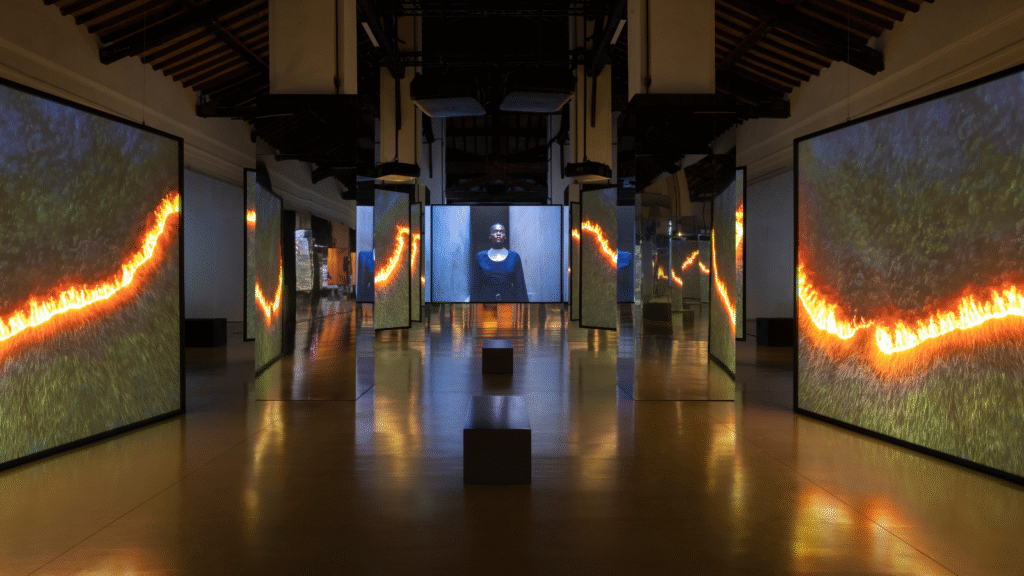
Sarmiento was awarded the Humanities Institute Moving Image Lab Fellowship based at the University of California Santa Cruz and Isaac Julien Lab in London. She is part of the second cohort of THI Moving Image Lab Public Fellows, working with curator and scholar Mark Nash. Collectively working in arts curation, exhibition production, and archival research, the 2025-26 fellows bring their academic expertise and scholarly interests to three esteemed arts institutions where they will hone their creative skills, foster relationships between the campus and community organizations, and gain professional experience that will help them succeed as artists, researchers, and curators after graduation.
Tag: UCSC
Picking up Shells Amid a Tsunami
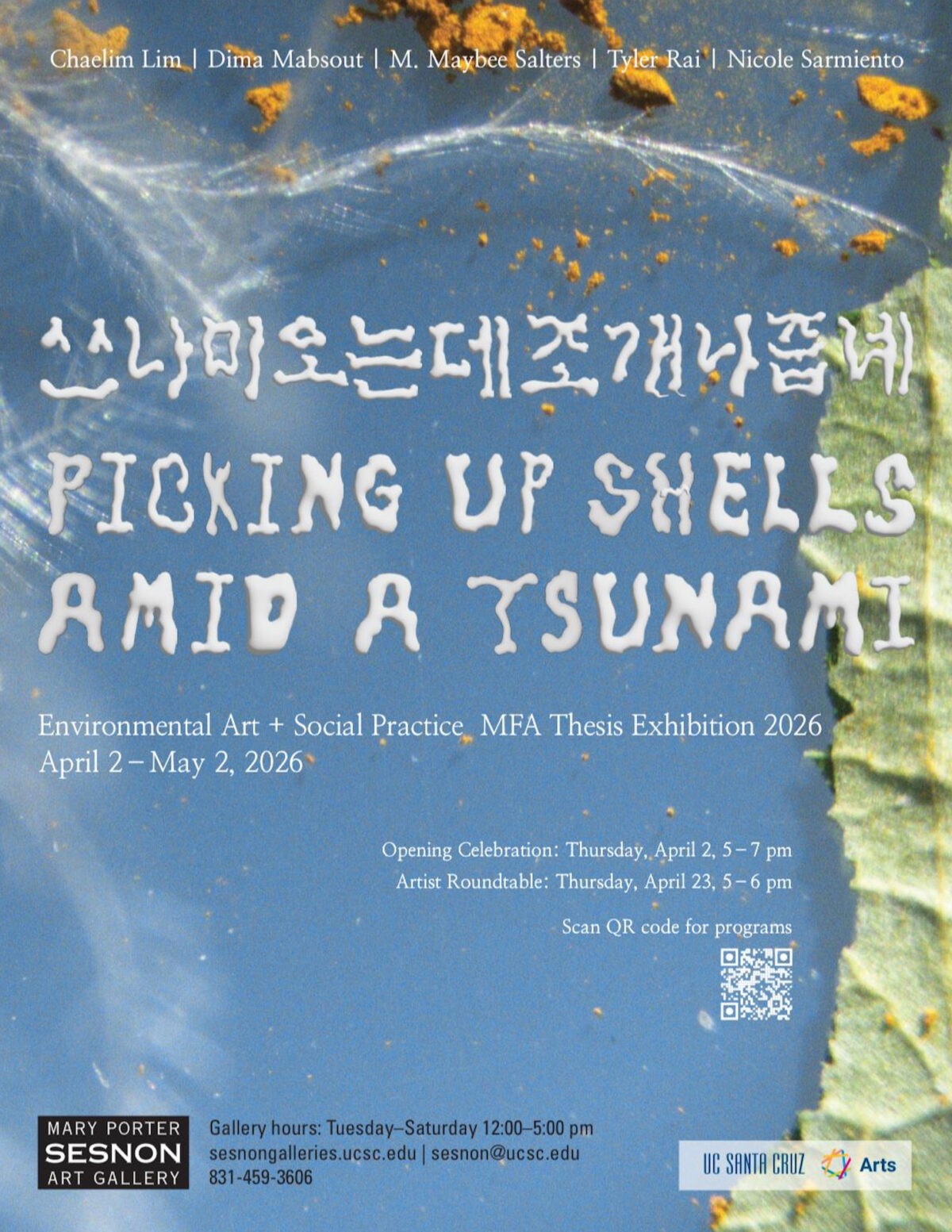
Sarmiento’s work is part of the culminating exhibition of the Environmental Art and Social Practice MFA program at UCSC presents new projects developed through concentrated inquiry over a two-year period and offers a window into the artists’ unique long-term research projects that expand beyond the gallery space.
Opening Thursday, April 2 2026
Picking up Shells Amid a Tsunami
쓰나미가 밀려오는데, 조개나 줍고 있네.
The phrase evokes a scene in which, amid an approaching catastrophe, someone appears to be idly picking up seashells. In South Korea, it gained political currency during the 2017 presidential impeachment protests, when feminist, disability rights, and animal rights groups were criticized for bringing their demands into the demonstrations. Their interventions were dismissed as distractions—acts of “picking up shells” at a moment when the sole priority was said to be the president’s removal.
We choose to pick up shells nonetheless. Not because the crisis is small, but because the shells matter. They are the body of the future, what accumulates slowly, what endures. One day, shells become mountains, and mountains become home. To pick up shells is not to turn away from urgency, but to insist on a future beyond it.
This exhibition comes together through an insistence on the opposite premise: that picking up shells while disaster is at our doorstep is not a distraction, but a necessity. What gets dismissed as marginal, secondary, a mere luxury, or mistimed, is precisely where social and political life becomes livable and where dreams, desire and the imagination open lines of flight towards other worlds.
Waves can level buildings once on the shore, dragging and revealing the damage as they recede. Rather than turning away from the storm, we acknowledge the multilayered and epistemic devastation caused by centuries of colonial, patriarchal, racist violence upon people, earth and more than human life. We witness the ongoing bifurcation of human and nature that is sedimented into our lives, languages and social, material, infrastructures.
The act of bending down to gather shells, ردم, fragments, sounds, 뼈, blue bottles, grotta, relationships, bodies, cries—composes a score that moves towards forms of care through minor gestures, embodiment, ritual, ofrendas, listening and beholding. Mundane and everyday poetics do not negate the scale of devastation and loss, nor do they refuse engagement. Rather, they bear witness. They reveal pathways towards endurance, negotiation, memory and imagination beyond colonial catastrophe. In this sense, the exhibition reframes the tsunami not as a singular event or metaphor, but an invitation for us to behold, actively look, to sit within the textures of tectonic plates and energy flows, at the conjuncture where plates meet, in the flow of energy through tempo, liquid, movement, land, sound, ecotone.
The wave does not demand one unified response. It forms part of a condition, a form of everyday accretion, a movement in and out of different temporalities. Picking up shells while the tsunami unfolds, amid the tsunami, alongside the water’s ebbs and flows, calls us to pay attention to overlooked lives, stories, bodies, memories, flows and relations, to transform materials so that they become reconstituted and are able to hold new and ongoing narratives that refuse to remain silent.