Special issue of Geoforum: Archives of the Planetary Mine, Nature, Culture and Extraction in the Americas.
Edited by Henrik Ernstson and Gianfranco Selgas
(Forthcoming)
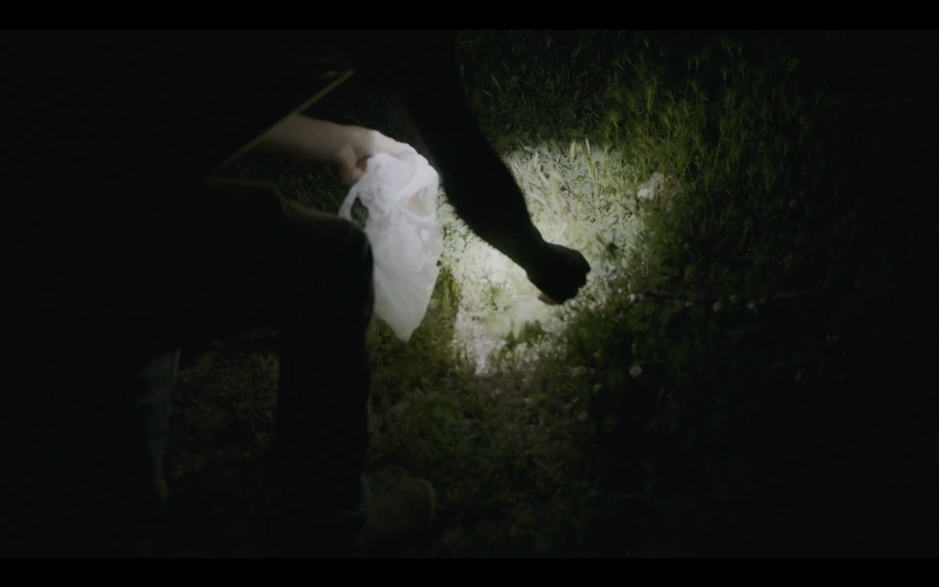
Image Credit: Manna, J. 2022, Screenshot from Foragers.
Sarmiento is a multidisciplinary artist who works alongside land, water and more than human allies, towards intergenerational and interspecies ways of living and working.
Special issue of Geoforum: Archives of the Planetary Mine, Nature, Culture and Extraction in the Americas.
Edited by Henrik Ernstson and Gianfranco Selgas
(Forthcoming)
Image Credit: Manna, J. 2022, Screenshot from Foragers.
Sarmiento was awarded the Humanities Institute Moving Image Lab Fellowship based at the University of California Santa Cruz and Isaac Julien Lab in London. She is part of the second cohort of THI Moving Image Lab Public Fellows, working with curator and scholar Mark Nash. Collectively working in arts curation, exhibition production, and archival research, the 2025-26 fellows bring their academic expertise and scholarly interests to three esteemed arts institutions where they will hone their creative skills, foster relationships between the campus and community organizations, and gain professional experience that will help them succeed as artists, researchers, and curators after graduation.
Sarmiento’s work is part of the culminating exhibition of the Environmental Art and Social Practice MFA program at UCSC presents new projects developed through concentrated inquiry over a two-year period and offers a window into the artists’ unique long-term research projects that expand beyond the gallery space.
Opening Thursday, April 2 2026
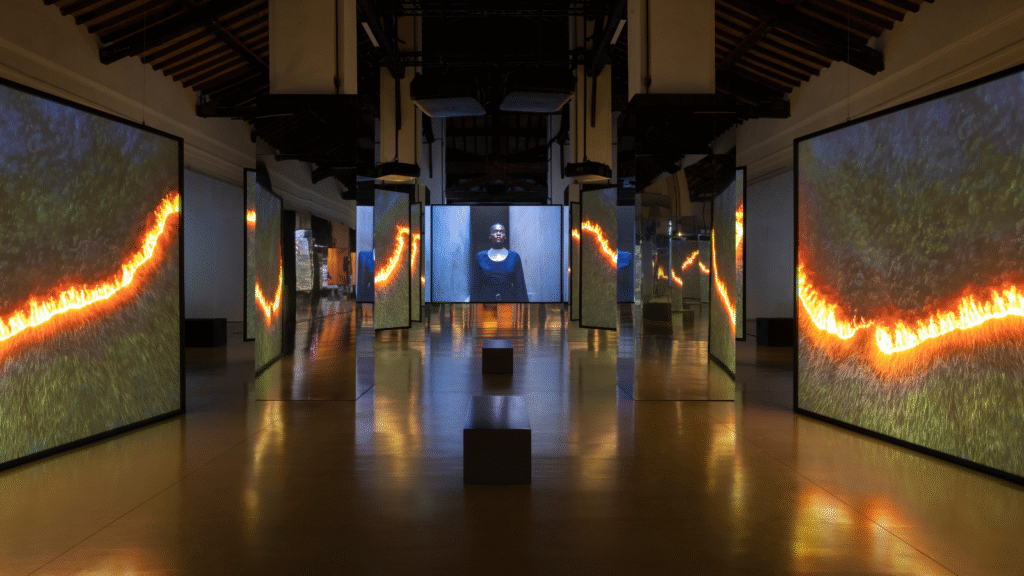
Picking up Shells Amid a Tsunami
쓰나미가 밀려오는데, 조개나 줍고 있네.
The phrase evokes a scene in which, amid an approaching catastrophe, someone appears to be idly picking up seashells. In South Korea, it gained political currency during the 2017 presidential impeachment protests, when feminist, disability rights, and animal rights groups were criticized for bringing their demands into the demonstrations. Their interventions were dismissed as distractions—acts of “picking up shells” at a moment when the sole priority was said to be the president’s removal.
We choose to pick up shells nonetheless. Not because the crisis is small, but because the shells matter. They are the body of the future, what accumulates slowly, what endures. One day, shells become mountains, and mountains become home. To pick up shells is not to turn away from urgency, but to insist on a future beyond it.
This exhibition comes together through an insistence on the opposite premise: that picking up shells while disaster is at our doorstep is not a distraction, but a necessity. What gets dismissed as marginal, secondary, a mere luxury, or mistimed, is precisely where social and political life becomes livable and where dreams, desire and the imagination open lines of flight towards other worlds.
Waves can level buildings once on the shore, dragging and revealing the damage as they recede. Rather than turning away from the storm, we acknowledge the multilayered and epistemic devastation caused by centuries of colonial, patriarchal, racist violence upon people, earth and more than human life. We witness the ongoing bifurcation of human and nature that is sedimented into our lives, languages and social, material, infrastructures.
The act of bending down to gather shells, ردم, fragments, sounds, 뼈, blue bottles, grotta, relationships, bodies, cries—composes a score that moves towards forms of care through minor gestures, embodiment, ritual, ofrendas, listening and beholding. Mundane and everyday poetics do not negate the scale of devastation and loss, nor do they refuse engagement. Rather, they bear witness. They reveal pathways towards endurance, negotiation, memory and imagination beyond colonial catastrophe. In this sense, the exhibition reframes the tsunami not as a singular event or metaphor, but an invitation for us to behold, actively look, to sit within the textures of tectonic plates and energy flows, at the conjuncture where plates meet, in the flow of energy through tempo, liquid, movement, land, sound, ecotone.
The wave does not demand one unified response. It forms part of a condition, a form of everyday accretion, a movement in and out of different temporalities. Picking up shells while the tsunami unfolds, amid the tsunami, alongside the water’s ebbs and flows, calls us to pay attention to overlooked lives, stories, bodies, memories, flows and relations, to transform materials so that they become reconstituted and are able to hold new and ongoing narratives that refuse to remain silent.
https://nyupress.org/9781776149483/restless-infections/
Nicole Sarmiento’s chapter in this book, ‘Haroon Gunn-Salie’s Submerged Disruption’ features in Part III: Land, Home Belonging.
Restless Infections is a collection of critical essays exploring artistic interventions in urban spaces, focusing on place-making and the politics of space in South Africa. The writers examine seminal artworks by South African artists, addressing diverse forms of expression such as site-specific performances, immersive installations, film, photography, and online performances.
The book is divided into three sections: The Restless City, Public Art for Multiple Publics, and Land, Home, Belonging. It introduces new perspectives on public sphere performance, such as Khanyisile Mbongwa’s re-imagining of township alleyways for public encounters and Mbongeni Mtshali’s study of everyday performances that challenge colonial and neo-colonial spatial organization.
The title, Restless Infections, is derived from the popular Infecting the City public art festival, symbolizing the persistent state of restlessness in a city still grappling with the legacies of colonialism, inequality, and racial segregation. This restlessness is tied to a desire for economic and political stability, expressed through transient art forms like Santu Mofokeng’s billboard photography.
The book shifts the focus of public art discourse in South Africa from static forms like monuments and statues to dynamic, temporary interventions that question the concept of publicness. These interventions engage with protest, public intimacy, audience interaction, and the disrupted topography of apartheid cities.
As the first scholarly volume to read public spheres through a multi- and interdisciplinary lens, Restless Infections argues that the diverse artistic modes explored are essential to understanding the complexities of publicness in South Africa.
Sarmiento completed her PhD in Visual and Performing Art from Durban University of Technology. Title of dissertation: ‘Of Art and Ecology:Anti-Colonial Methodologies in Artistic Practice’
Abstract
This dissertation seeks to make a methodological contribution to the fields of visual art. Anchoring this study in artworks that are at once visual, textual, audio-visual, embodied, the works I look at move across South African, Brazilian, Palestinian and US landscapes and histories.
The artworks that ground this dissertation are by artists Haroon Gunn-Salie, Imani Jacqueline Brown, Forensic Architecture and Jumana Manna. The works grapple with contested land and a failure of post-apartheid justice in contemporary Cape Town; a city in Mariana, Brazil covered in toxic mud and the calls for ecological clean-up that remain unresolved; petrochemical corridors in New Orleans built upon layers of plantation economies and racial slavery; enslaved ancestors buried within regimes of care where body, land, water, trees, caress, hold and speak; scientific/legal regimes that police Palestinian herb-picking cultures and criminalize foragers, using ecological veils for policies aimed at further alienating Palestinians from their lands that they were forcibly removed from. Submerged in these works, their methods and the stories they tell, this dissertation places art in conversation with memory, land, restorative justice and ecological resistance – opening up space/time in ways that unfasten linear progressive time and offer alternative visualities.
In this dissertation, I look at how the artists engage questions of the living world and human entanglements with water, soil, plants, and memory in ways that refuse land/nature as an abstracted object/thing, seeing land as more than monetary value or extractive potential. These visions of land and ecosystems move towards complex, intimate, submerged ways of seeing that relate to land as space/time that carries memory, that is sentient and inseparable from human life. I illustrate the ways these works and their methods provide rich terrains of scholarly and creative engagement.
Through the lens of these works and the contexts of their creation, exhibition, and circulation – I place seemingly distinct realms of art and ecology in the same frame. Art and ecology may appear to be separate, disconnected disciplines and practices. However, they both speak of visible and invisible, life and death, visual and embodied, material and ephemeral, history and memory, relationship and community. Art and ecology converge to offer traces, textures, plant/human intimacies, botanical and sedimentary archives that speak to ecological resistance and desire.
Grounded in the multisensorial grammar of these artworks, and the literature and scholarship this dissertation threads together, this thesis hopes to move beyond simplistic, homogenizing labels and disciplines towards transdisciplinary methodologies of care and relationality that tend to desire, disrupt linear temporalities and offer futures of care, ecological resistance and decolonisation.
Supervisors: Dr. Sara Dehkordi and Dr. Heeten Bhagat
This set of foraging walks, food, herb and seed shares and curated film screenings was put together by collaborating artists Nicole Sarmiento, Ismail Farouk and Yasmin Meyer.
In ‘Archives of the Botanical’ you were invited to a day of film screenings, walks and seed/herb shares for Palestine. Alongside the work of visual artist and filmmaker Jumana Manna, and the film of scholar, author, filmmaker collaborators Heidi Grunebaum and Mark Kaplan, we invite a multisensorial engagement with land, seeds, herbs, botanical archives and food, channeling solidarity with the ongoing struggle of Palestinians and marking the historic case of South Africa v. Israel at the International Court of Justice (ICJ).
This set of screenings and embodied interventions approaches questions of land, memory, ruins and fugitivity alongside botanical archives. Exploring plant/human intimacy, legal/scientific regimes of occupation in Palestine/Israel and the stories that plants tell, these works offer memory, knowledge, caretaking and refusal in the context of ongoing occupation and capitalist relations of extraction.
Foragers (2022) by Jumana Manna
Foragers depicts the dramas around the practice of foraging for wild edible plants in Palestine/Israel with wry humor and a meditative pace. Shot in the Golan Heights, the Galilee and Jerusalem, it employs fiction, documentary and archival footage to portray the impact of Israeli nature protection laws on these customs. The restrictions prohibit the collection of the artichoke-like ’akkoub and za’atar (thyme), and have resulted in fines and trials for hundreds caught collecting these native plants. For Palestinians, these laws constitute an ecological veil for legislation that further alienates them from their land while Israeli state representatives insist on their scientific expertise and duty to protect. Following the plants from the wild to the kitchen, from the chases between the foragers and the nature patrol, to courtroom defenses, Foragers captures the joy and knowledge embodied in these traditions alongside their resilience to the prohibitive law. By reframing the terms and constraints of preservation, the film raises questions around the politics of extinction, namely who determines what is made extinct and what gets to live on.
The Village Under the Forest (2013) by Mark J. Kaplan and Heidi Grunebaum
The Village Under The Forest explores the hidden remains of the destroyed Palestinian village of Lubya, which lies under a purposefully cultivated forest plantation called South Africa Forest. The Village Under The Forest unfolds as a personal meditation from the Jewish Diaspora.
Using the forest and the village ruins as metaphors, the documentary explores themes related to the erasure and persistence of memory and dares to imagine a future in which dignity, acknowledgement and co-habitation become shared possibilities in Israel/Palestine. The Village Under The Forest won the Audience Award at Encounters South African International Documentary Festival in 2013
Exhibition text by Nicole Sarmiento for Alka Dass solo show at Whatiftheworld gallery
The Blue House invites us into a world of works that continue an ongoing dialogue with and playful querying of family photographs, personal archives, objects and ephemera. Alka Dass brings us into textures of the intimate and mundane, scripted and performative, sacred and profane, of everyday image-making – and how these allow her to reconsider, reconstruct, remember and suture people, place, memory, history, time and desire in ways that move outside of dominant discourses and archival logics, opening space for a sensing and perceiving that is active and unruly.
Dass’ starting point is always the personal and experiential: her own multi-generational archives, the stories they tell, the people, places and times they belong to, in intimate and ludic relationship to the handmade and slightly unpredictable nature of cyanotype – its sensitivity to light, moisture, material and environment. The artist’s works are sutured with the whimsical, symbolic, patterned needlework of embroidery on canvas, offering compositions that bleed and layer, speak and sound, touch and haunt – disrupting the photographic frame and its logocentric assumptions.
Steeped in colour, viscosity and the vibrancy and vulgarity of blues interrupted and caressed by pinks and reds – the chromatic disquiet of Dass’ tapestries dazzle and distend in an ecosystem of her creation. As Tina Campt writes, family photographs, portraits, identity photos and snapshots of everyday life are submerged in the affective, symbolic and embodied economies of their creation, circulation, exchange and storage. Family photographs are felt, heard and bear upon us in myriad ways, and their existence exceed the origins of their creation; they are, furthermore, meaningful not only in their singularity and uniqueness, but also in their plurality, as they relate to and are entangled within a broader set of visualities and representational politics.
Jordan Nassar writes of Palestinian embroidery that it offers “[geometry], superstition and magic, social cues, family and village associations, embellishment and more.” Building on Nassar’s view of the worlds contained within the stitched form, Dass’ layered compositions offer prosthesis – artificial limbs or parts that help the images walk, sound, move, outside of enclosures. Other times, the threads conjure symbol, gesture, detail, citation or translation in ways that elevate the subjects, that refuse forms of surveillance and capture, offering instead masking, laughter and opacity as forms of knowing. With a rhythm constructed between image and its properties, the works formulate grammars and animacies for moving outside of hegemonic preservationist logics. Everyday photographs are reconfigured into tonalities, textures, saturations left behind by chemical solution and their traffic with the living world, traversed and mapped by thread, beadwork and lines of flight.
Scenes of love, joviality, celebration and desire are marked by repressed histories that refuse to disappear into the past, or to exist as background. Time instead is layered, with past, present and future bleeding into one another, like tea bags in water. Subjectivity, identity and place become maps transgressed and borders crossed, reconfiguring what we think we know. Dass’ works recall Anne Stoler’s notion of imperial ruination as structure and process – allowing us to consider accretion, decomposition, detritus, residues and ruins as active ways in which colonial and apartheid histories structure the present.
Layers of chemical solution, the imprint of sunlight on canvas, the haptic, gentle, incendiary and rhythmic forms of carving needle and thread into fabric, offer visual codes that speak to what lies outside of the frame, to the silences held within point and shoot imaginaries. The Blue House brings us into fugitive dreams and desires that reappear, repressed histories that return and rupture. Dass’ azure ecosystem destabilizes the dominant gnosis of the archive, towards the everyday and the familiar, masking and play, as alternative forms of care, knowledge and world-making.
As a fellow and collaborator in the re-imagining of non-profit organization Art for Humanity (AFH), based at Durban University of Technology, Sarmiento assisted in transforming the space to allow for public programming, exhibitions and workshops. In addition to this interior spatial work, she assisted in developing the public program, research emphasis, pedagogy, website and overall vision of AFH.
Work from Land and Erasure I and II exhibited at International Symposium on Electronic Art hosted in Durban, South Africa 2018.
Together with many others we organized unschooling/self directed and intergenerational forms of gathering and being together in learning communities in Durban, South Africa. Hosting gatherings, workshops, short term childcare collectives, decolonial dinners, food growing/seed shares, among many other forms of gathering and being in relationship with children beyond the superstructures of school and other institutions that govern adult-child relationships.